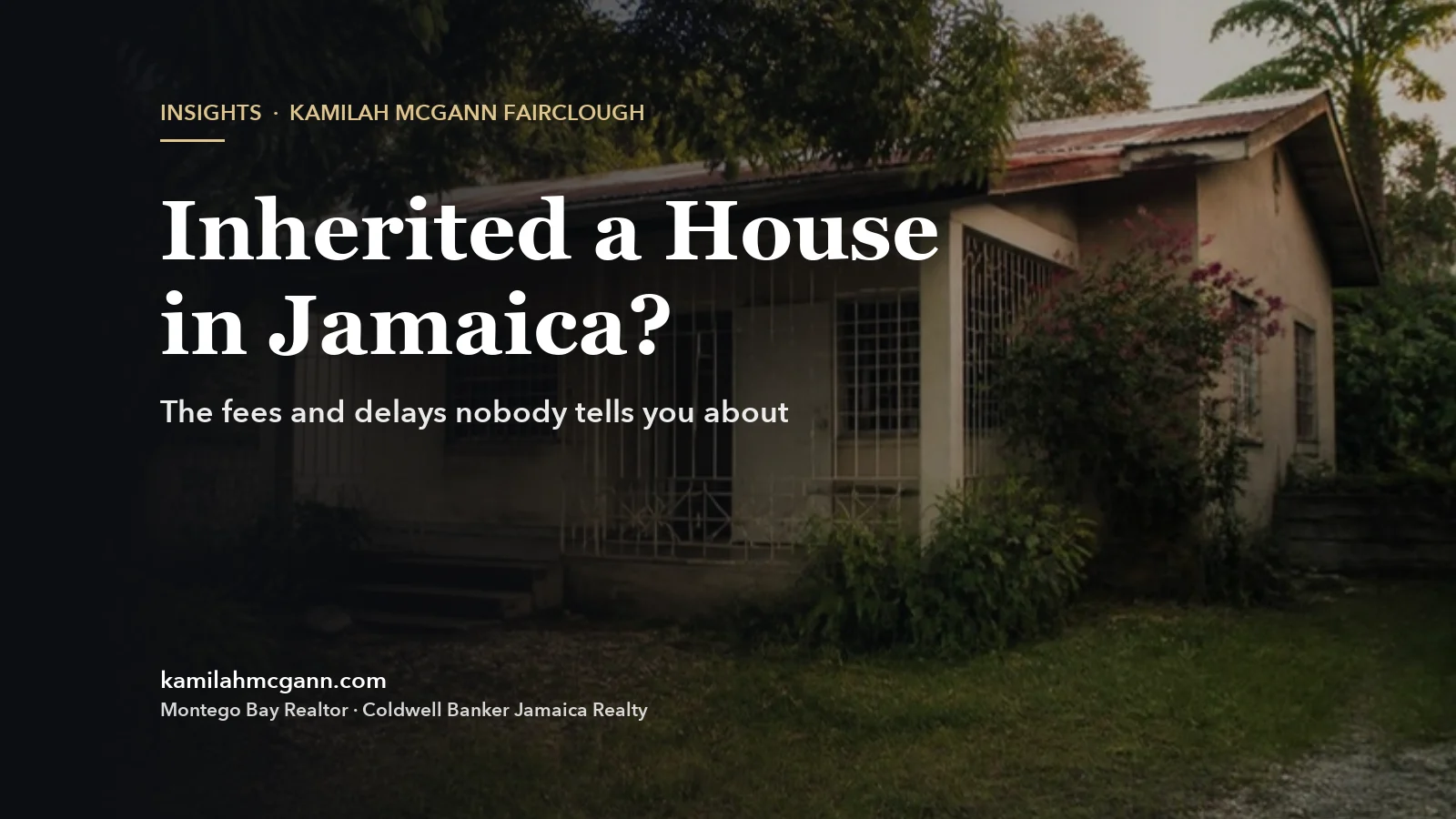
You usually cannot sell an inherited property in Jamaica until the estate is administered. That means a Grant of Probate if there is a will, or Letters of Administration if there is not, and then registering the executor or beneficiaries on the title. Estates above J$10 million pay estate transfer tax on real estate and shares, due within a year of death with interest after that. Once you sell, expect 2% transfer tax, a share of registration fees, agent commission plus GCT and legal fees plus GCT. Family land with several heirs needs everyone’s agreement, or a court.
Some of the most emotional calls I take start like this: “Mummy passed, the house is just sitting there, and the family wants to sell.” Often the caller lives in Toronto, Brooklyn or Birmingham. Often there are siblings in three countries. And very often, the paperwork from the last generation was never finished either.
Selling inherited property in Jamaica is absolutely possible. But it is a sequence, not a single transaction, and every step has a cost and a timeline. Here is what nobody tells you at the start.
Step 1: No sale until the estate is sorted
The name on the title is still the name of the person who died. Before anyone can sign a transfer, the estate must be administered. If there is a will, the executor applies for a Grant of Probate. If there is no will, a family member applies for Letters of Administration. The National Land Agency describes probate as a grant through the Supreme Court or the Parish Court that confirms the will and authorises the executor to deal with the estate.
The hidden cost: time. Gathering documents, advertising, valuations and court processing can take many months, and longer if the estate is complicated or family members disagree. A buyer will not wait for that, so start the estate work before you start marketing.
Step 2: The death duty many families forget
Since 1 April 2019, Tax Administration Jamaica has applied a nil rate of estate transfer tax on the first J$10 million of an estate’s value. Above that threshold, law firm DunnCox explains that transfer tax on death is charged at 1.5% on the value of real estate and shares owned at the date of death. It is due within the year after the death, and after that interest accrues, which DunnCox puts at 6% a year. Stamp duty on estate documents is small, a flat J$5,000 above J$500,000, but it must be paid before the application to court.
The hidden cost: interest. Families who wait years before starting can find the bill has grown. Ask your attorney for a valuation as at the date of death and an estimate early.
Step 3: Putting the right names on the title
With the grant in hand, the executor or administrator applies to the National Land Agency to be registered on the title, a process known as transmission. From there the property can either be sold by the executor, or transferred to the beneficiaries first.
If the land was never registered: roughly 40% of land parcels in Jamaica have no registered title. If the family land is one of them, it may need to be registered before a buyer, or a buyer’s lender, will accept it. Build that into your timeline.
Step 4: Family land and the agreement problem
When several heirs share a property, every one of them usually needs to agree to the sale, the price and how the money is split. One sibling who will not sign, or cannot be found, can stop the whole process. Relatives overseas can take part through a registered power of attorney. Where agreement is impossible, the courts can be asked to order a sale, but that adds time and cost.
What helps: a family meeting early, one trusted person to coordinate, an independent valuation everyone accepts, and everything in writing.
Step 5: Protect the house while you wait
An empty house is vulnerable to damage, theft and, over time, adverse possession. Under the Limitation of Actions Act, someone who occupies land for 12 years may in some circumstances claim it, although the courts look carefully at the kind of possession and whether permission was given. If a relative or caretaker is living there, put the arrangement in writing now. Keep the property taxes paid, since you will need a certificate of payment of taxes to sell.
Step 6: The seller’s costs
When you finally sell, these are the main costs to plan for:
- Transfer tax: 2% of the market value, customarily paid by the seller, according to Tax Administration Jamaica.
- Stamp duty: a flat J$5,000 on the agreement for sale and the transfer where the price is J$500,000 or more, often shared.
- Registration fee: described by the Jamaica Information Service as 0.5% of the price, commonly shared between buyer and seller.
- Agent’s commission: commonly around 5% of the price, plus GCT. Agree it in writing.
- Your attorney’s fees: usually a percentage of the price, plus GCT. Ask for a written quote that separates the estate work from the sale.
- Arrears: any outstanding property tax, water and utility bills must usually be cleared before completion.
One published 2024 breakdown estimated a seller’s total costs at close to 12% of the price when commission and legal fees are included. Your figure will depend on what you negotiate, but it is wise to plan for a significant slice of the sale price going to costs, before the estate work is counted.
The good news: Jamaica has no capital gains tax on property. If the value rose sharply since your parents bought, the transfer tax is charged on the sale value, not on the gain, and PwC notes a refund is available where the transfer tax exceeds 37.5% of the capital gain. If you live abroad, check how the sale is treated where you pay tax too.
My advice
Start the estate work the moment the family is ready, not the moment a buyer appears. Get a valuation, get the title in order, agree as a family, and protect the house while you wait. When you are ready to sell, I can help you price it properly, prepare it for the market and work alongside your attorney so the sale completes smoothly, even if half the family is overseas.
Related reading: 9 traps to avoid when buying land in Jamaica and where Jamaicans abroad are buying now.
Frequently asked questions
Can I sell an inherited house in Jamaica without probate?
Usually not. The estate normally needs a Grant of Probate, where there is a will, or Letters of Administration, where there is not, and the executor or administrator must be registered on the title before the property can be transferred to a buyer. Speak to a Jamaican attorney about your specific case.
Is there inheritance tax in Jamaica?
Jamaica charges transfer tax on death rather than a separate inheritance tax. Since 1 April 2019 there is a nil rate on the first J$10 million of an estate, and above that transfer tax is charged at 1.5% on real estate and shares. It is due within a year of death, with interest after that.
What are the seller’s costs when selling property in Jamaica?
The main costs are transfer tax of 2% of market value, a share of the J$5,000 stamp duty and the registration fee, the agent’s commission, commonly around 5% plus GCT, the seller’s attorney’s fees plus GCT, and clearing any property tax or utility arrears.
Do all heirs have to agree to sell family land in Jamaica?
Where several people share ownership, all of them usually need to agree and sign. Overseas heirs can act through a registered power of attorney. If agreement cannot be reached, the courts may be asked to order a sale.
Is there capital gains tax on selling property in Jamaica?
No. Jamaica does not charge capital gains tax on property. The seller customarily pays transfer tax of 2% of the market value instead. Owners who live abroad should check whether tax is due where they live.
Who can help me sell an inherited property in Montego Bay?
Kamilah McGann Fairclough is a Montego Bay real estate and investment consultant with Coldwell Banker Jamaica Realty and a Top 10 Producer in 2024 and 2025, who works with families at home and overseas. Call or WhatsApp +1 876 324 6295.